Power Regulator
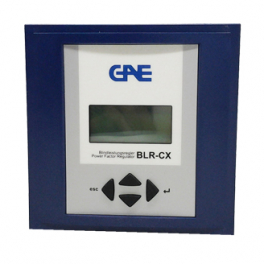
BLR-CX is equipped with LCD with backlit. It shows information about the panel and about the mains parameters. It’s also necessary for setting.
Display of Information
Description
All relevant parameters for the regulation are set ex works in the way that in nearly all cases for BLR-CX no further adjustments are necessary to start the regulation. An optimization of the control mode of the compensation panel to the local conditions is still possible. Parameters can easily be changed, also during operation.
These settings can be done in two separate user menus. The "Start" menu contains only the settings, which can be necessary for commissioning, like nominal voltage, CT and VT ratio and the automatic correction of current and voltage connection.
These and furthers settings of the "Expert" menu are:
Measuring: nominal voltage, CT ratio, VT ratio, tolerance of voltage, connection Ph-Ph/Ph-N, phase-correction, autom. correction of connection, synchronization, reset operating hours, reset average PF, reset max. temperature, temperature offset
Regulation: sensitivity, target-cosphi 1 and 2, switch interval, delay step exchange, stepexchange, autom. capacitorsize detection, blocking of defective steps,Regul.progr.: Best-Fit, LIFO, combi, progressiv, Offset reactive power, asym.-switch interval, avoid leading power factor.
Steps: discharging time, step size in kvar, steptype (e.g. Fix-steps), reset step database
Alarming: regulation alarm, defective step alarm, power loss of capacitors, THD U Alarm, overtemperature, limit switching operations, limit OPH of panel, limit temp1/temp2 I=0 alarm (failure in current path), etc.
To start regulation, only the correct setting of nominal voltage is necessary. Differing voltage is blocking control function for protecting the capacitors. If CT ratio is not set, then measurement readings which depend on current are blanked. A wrong connection can be corrected by starting the automatic phase correction. For maintenance work, each individual step can be switched manually.